
String processing reimagined for ALTREP strings
charr is an experimental fork of stringr. The functions and semantics are the same but everything is optimized around ALTREP strings (custom high-performance string storage), allowing for faster and more efficient operation.
charr reimplements stringr’s API and provides three different backends: the reference implementation from stringr, an optimized base implementation using ordinary strings, and the default altrep implementation that returns ALTREP strings. The three backends are semantically interchangeable.
This work is supported by the R Consortium Infrastructure Steering Committee, under the grant Universal ALTREP Interoperability for Strings.
Benchmark
The figure below compares charr’s default setup, the ALTREP backend on a single thread, with the reference backend. It covers thirteen representative operations from across the package, measured on a multilingual Tatoeba dataset. Each bar is the median of five runs and its length is how many times faster charr is than the reference.
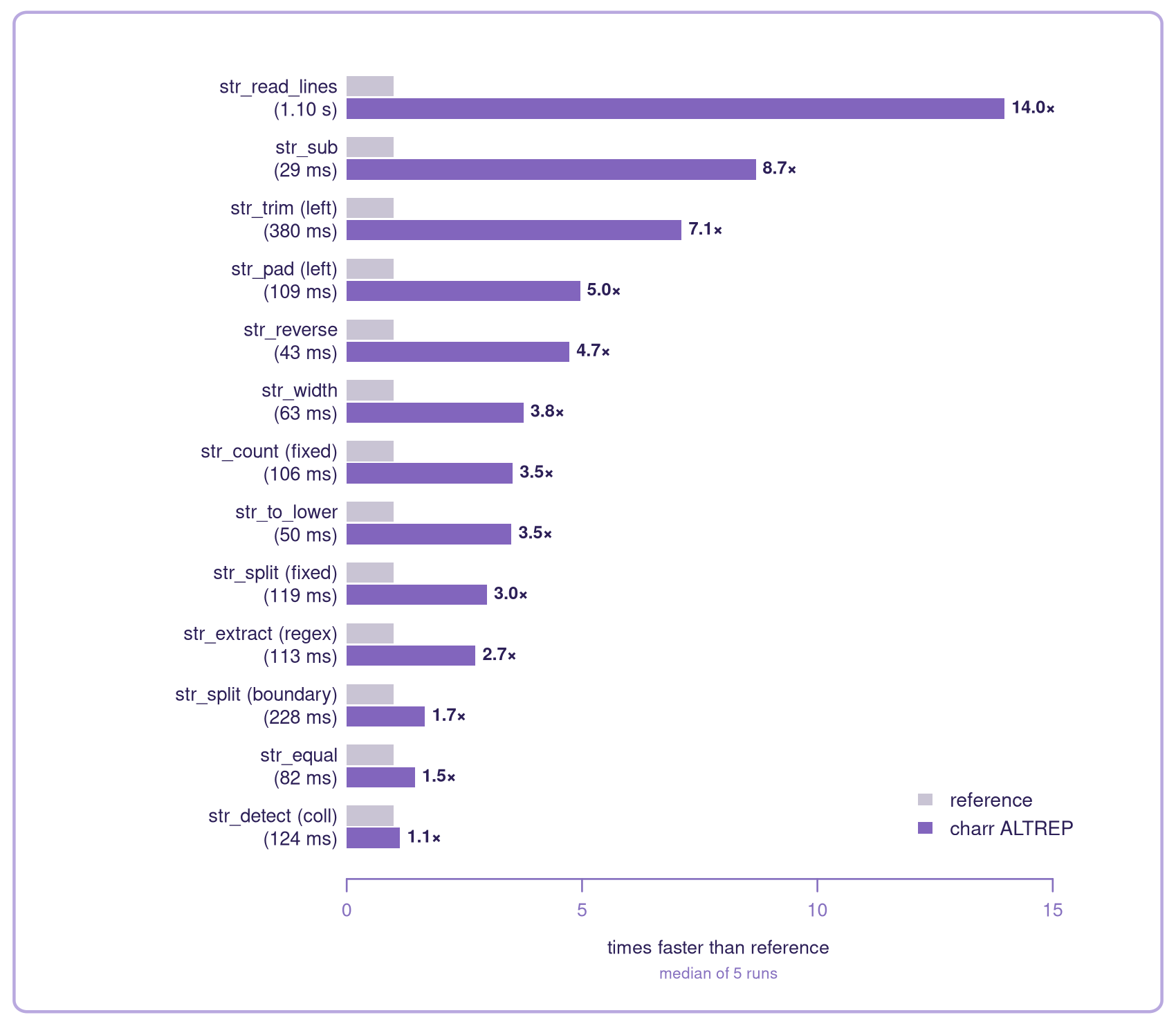
The speedup comes from two things: ALTREP strings avoid much of the overhead of R string storage, and the string operations themselves are rewritten in optimized C++. Most operations can also split their work across threads with charr_threads(), which speeds them up further on large inputs.
Under the hood has the complete benchmark record across all stringr operations.
Choosing a backend
charr_backend gets and sets the way strings are processed for all operations. The default is altrep:
charr_backend()                  # returns current value, default "altrep"
prev <- charr_backend("base")    # Optimized functions using ordinary strings
charr_backend("reference")       # Original stringr reference
Under altrep, passing one charr call’s output into the next keeps the data in ALTREP form the whole way; nothing materializes until something outside charr asks for ordinary strings.
The charr_backend selection is stored as an option so you can retrieve it with getOption("charr_backend").
Additional functions
charr includes a few functions stringr does not have, and more may be added over time.
-
str_reverse()reverses each string by Unicode code point -
str_read_lines()reads a file, converts it to UTF-8, and splits it at Unicode line boundaries. It is the fastest way to get text intocharr -
str_write_lines()writes each string as a line to a file, converting it to the requested encoding. It is the counterpart ofstr_read_lines()
See also
- Under the hood: the three backends, the ICU and C++ choices, and the full per-operation benchmark.
- Code map: an interactive view of the native source graph, generated from Clang’s semantic model.
-
charport: the ALTREP string interoperability layer
charris built on.